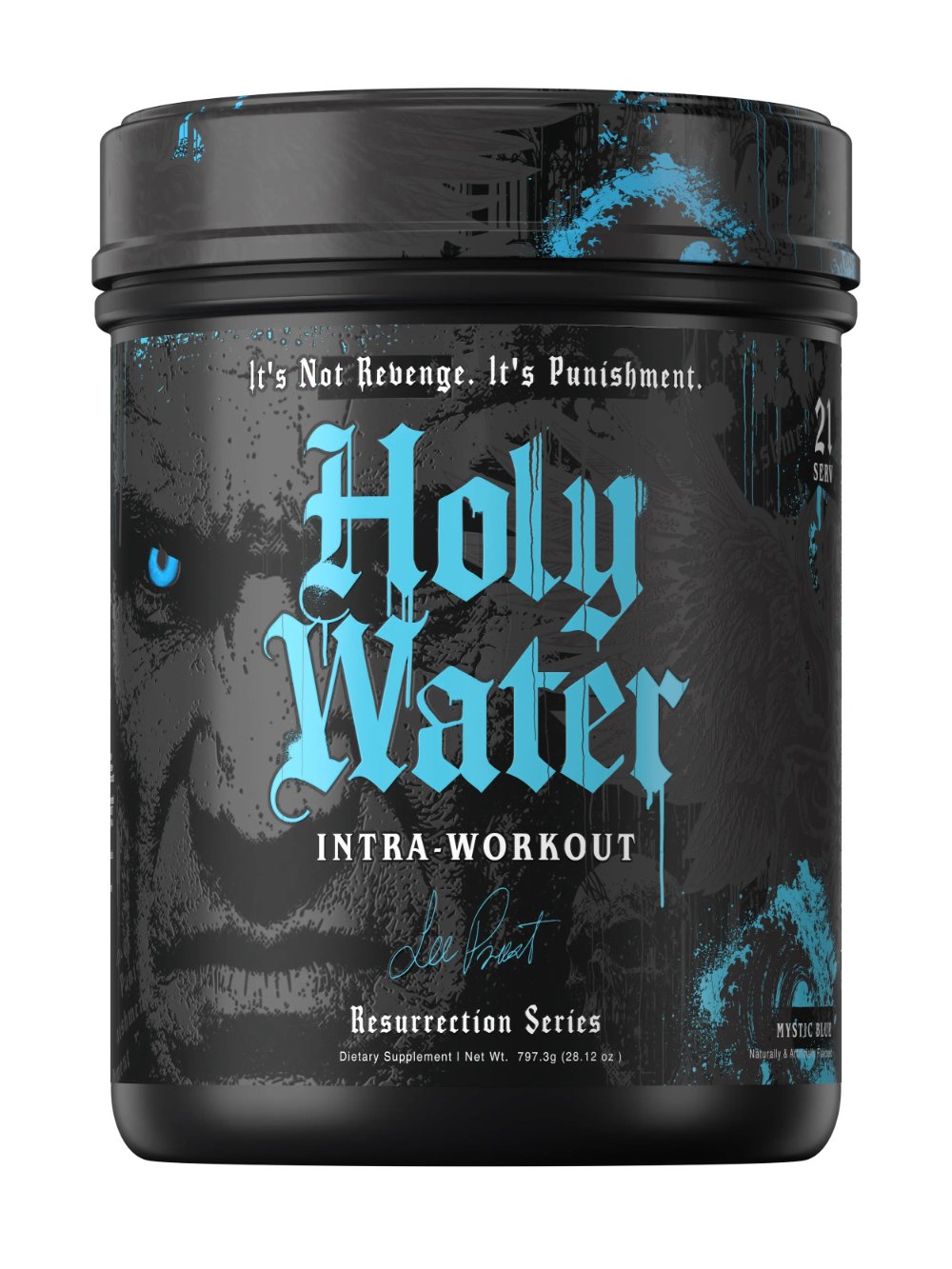
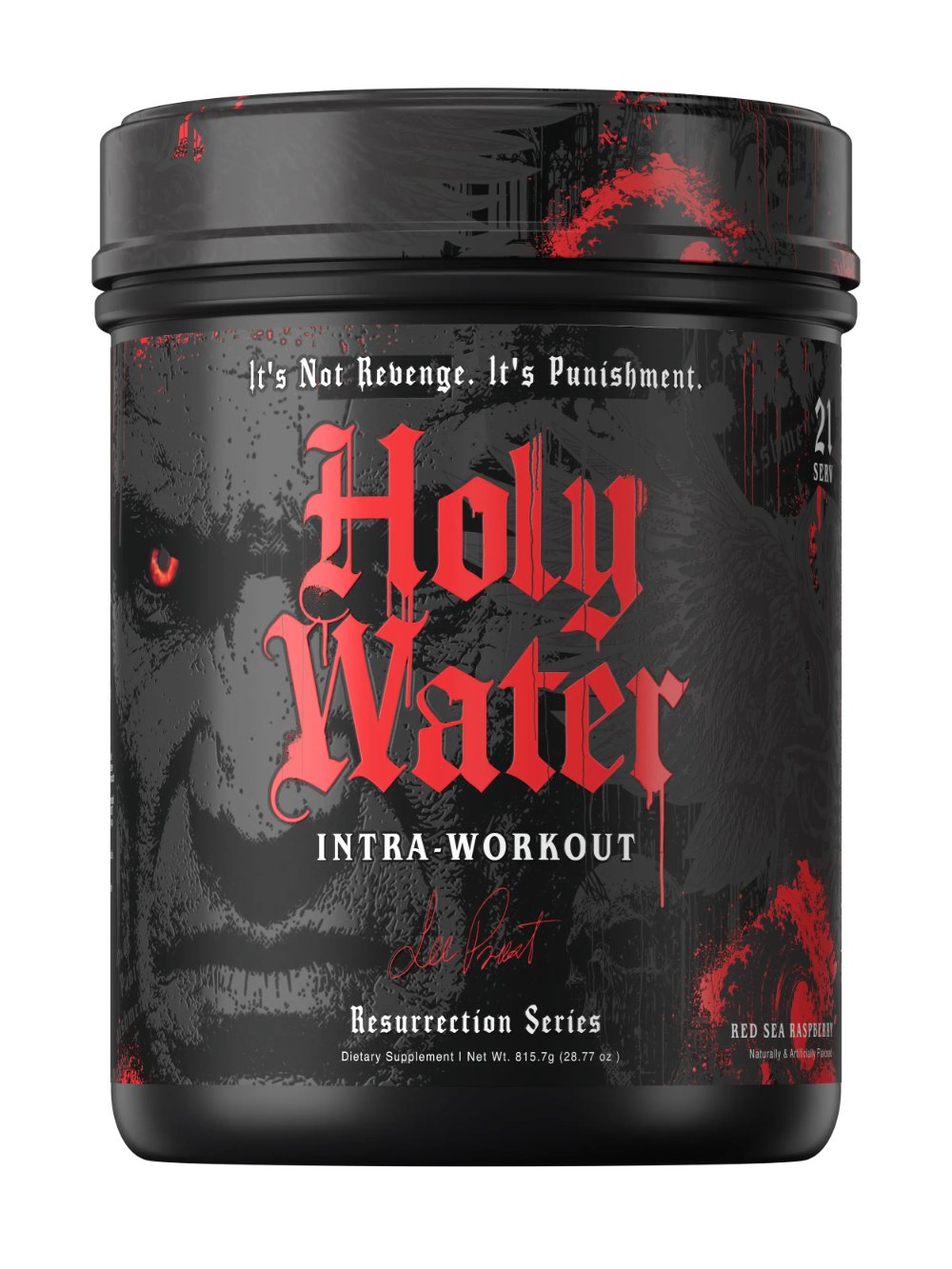
Lee Priest and NutriFitt just released the second product in their Resurrection Series, and this one caught my eye for a simple reason: the Holy Water intra-workout puts 2.5 g of goBHB® right next to 10 g of dextrose in every scoop. NutriFitt listed it on its store on October 23, 2026, and Stack3d covered the launch the next day. It sells for $49.99 for 21 servings in two flavors, Mystic Blue and Red Sea Raspberry.
I get asked about carb-plus-ketone formulas a lot, usually by brand owners deciding whether BHB belongs in a during-training drink. So below I break down every ingredient on the Holy Water label, show where 2.5 g of goBHB sits next to the doses used in human research, and give you my honest read on what that amount can and can’t do. Full disclosure: goBHB Labs supplies the BHB in this product.

What Is the Holy Water Intra-Workout?
Holy Water follows Crucifix, the stimulant-heavy pre-workout that opened the Lee Priest collaboration. The new formula goes the other way on stimulants (there are none) and focuses on the part of the session where most people drink water and nothing else. NutriFitt describes it as a performance, endurance, recovery and hydration formula, and the label backs that up with a long ingredient list at real doses.
The product page copy reads like a gym poster, which fits Lee Priest:
“This is your ritual. This is your discipline.”
NutriFitt, Holy Water product page
You can find it on the NutriFitt Holy Water page. Per the Stack3d launch report, it sells direct from NutriFitt.
Holy Water Ingredients, Scoop by Scoop
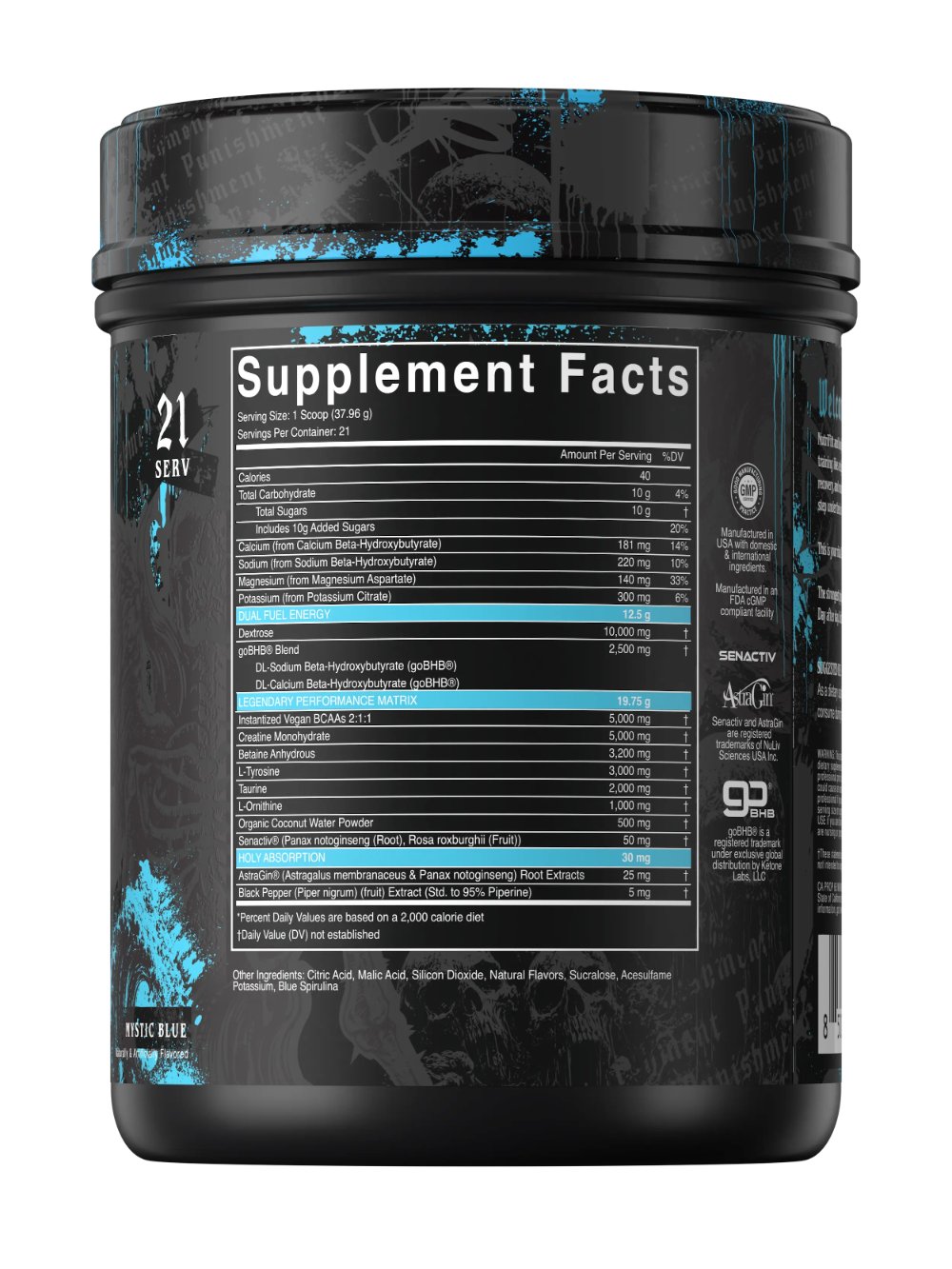
Here is the full label as NutriFitt lists it, per scoop. The Senactiv amount comes from Stack3d, since the product page doesn’t print it.
| Ingredient | Per scoop | Role on the label |
| Dextrose | 10 g | Fast carbohydrate |
| goBHB (sodium and calcium BHB) | 2.5 g | Exogenous ketone |
| Vegan BCAAs (2:1:1) | 5 g | Amino acids |
| Creatine monohydrate | 5 g | Strength and power |
| Betaine anhydrous | 3.2 g | Performance |
| L-tyrosine | 3 g | Focus |
| Taurine | 2 g | Performance |
| L-ornithine | 1 g | Amino acid |
| Senactiv | 50 mg | Recovery |
| Electrolytes (K, Na, Ca, Mg) | 841 mg total | Hydration |
| Coconut water powder, AstraGin, black pepper extract | Not listed | Hydration and absorption |
The electrolyte line breaks down to 300 mg potassium, 220 mg sodium, 181 mg calcium and 140 mg magnesium. Some of the sodium and calcium comes from the goBHB itself, because BHB salts are BHB bound to minerals. That is one reason I like BHB salts in a hydration-style product: the ketone and part of the electrolyte load arrive together.
The 5 g of creatine is the full daily dose most research uses, so anyone drinking Holy Water on training days can skip a separate scoop. The 3 g of tyrosine carries over from Crucifix. Outside the BHB, nothing here looks underdosed for show, which I can’t say about most intra-workouts I see.
Why Pair Dextrose With goBHB in an Intra-Workout?
NutriFitt calls the 10 g of dextrose plus 2.5 g of goBHB “dual fuel energy.” The idea of giving working muscle carbs and ketones at the same time comes mostly from a 2016 Oxford study in Cell Metabolism by Cox and colleagues. Trained cyclists who drank a ketone ester with carbohydrate rode roughly 2% further (about 400 meters) in a 30-minute time trial than when they drank carbohydrate alone. That study used a ketone ester at a large dose, not BHB salts, and the Oxford group behind it holds intellectual property on that ester, so I read it as proof of concept rather than proof that every carb-plus-ketone drink works.
Later trials with BHB salts have been mixed, and I went through them in detail in our review of ketone supplements for performance. My short version: ketones are not a proven ergogenic aid at small doses, and anyone who tells you 2.5 g will add 400 meters to your ride is overselling.
What the carbs do to your ketone levels
There is a real tradeoff here. Eating raises insulin, and insulin slows the body’s own ketone production. In a 2017 Oxford study by Stubbs and colleagues, a meal lowered the peak blood BHB from a ketone ester drink by about a third. The same paper found that, at matched doses, BHB salts produced a lower D-BHB peak than the ester (1.0 vs. 2.8 mM), with levels back to baseline within 3 to 4 hours. So in Holy Water, think of goBHB as a modest, short-lived top-up of an alternative fuel during the session, not a way to put you in ketosis while you sip dextrose.
How 2.5 g of goBHB Compares to Research Doses
Dose matters more than any label claim, so here is how one Holy Water scoop lines up against the daily BHB amounts used in published human trials.
How much BHB: Holy Water vs. human trials
Grams of BHB per serving or per day, as labeled. Blue = Holy Water; grey = doses used in published trials.
Sources: Katsuya et al., Obesities 2025; Roeth et al., Nutrients 2025; NutriFitt label.
A 12-week Japanese trial by Katsuya and colleagues gave 1.5 g or 2.9 g of D-BHB a day to 100 adults (BMI 23 to 30) with higher visceral fat, and both doses reduced visceral fat area compared with placebo (by 10.6 and 10.9 cm²). The authors are affiliated with Osaka Gas, which makes that D-BHB. The 8-week KETAD trial (Roeth 2025) used 5 g of D/L BHB salts twice a day alongside a modest calorie deficit. People on BHB lost 1.97 kg of fat mass vs. 0.82 kg on placebo, though the between-group difference was a trend rather than statistically significant. Ketone Labs funded that study. Neither trial tested an intra-workout drink or exercise performance, so these numbers tell you about dose range, not about what Holy Water does in the gym.
Where the Evidence Stands
What we know: BHB salts raise blood ketones for a few hours, the body readily uses that BHB as fuel, and daily doses from 1.5 g to 10 g were well tolerated in human trials, with mild side effects at rates similar to placebo. Keep in mind that grams aren’t equivalent across forms: pure D-BHB raises blood levels more per gram than a D/L blend, and NutriFitt doesn’t say which form Holy Water uses. Carb-plus-ketone fueling rests mainly on one well-known ester study, and follow-up trials have been mixed. What we don’t know: whether 2.5 g of goBHB inside a carb, creatine and amino acid drink changes training output. Nobody has tested Holy Water itself, and I won’t pretend otherwise.
If you want more BHB, stack it. A 5 g serving of a straight goBHB product before training, plus Holy Water during, gets you closer to the doses the trials used.
Who Should Use Holy Water, and Who Should Skip It
It fits long or high-volume sessions where you want carbs, creatine, aminos and electrolytes in one bottle without stimulants, especially if you train late or already use a stim-heavy pre-workout.
A few safety notes. Each scoop has 220 mg of sodium plus other minerals, so if you have high blood pressure or kidney problems, or you watch your sodium for any medical reason, talk to your doctor first (I covered mineral load in our post on BHB salts side effects). The 10 g of dextrose adds about 40 calories of sugar, which matters if you track carbs. Pregnant or nursing women and anyone on prescription medication should check with a physician before starting a new supplement.
FAQ
How much goBHB is in Holy Water?
Each scoop contains 2.5 g of goBHB as sodium and calcium BHB, according to NutriFitt’s label. That sits between the 1.5 g and 2.9 g daily doses used in the Katsuya visceral fat trial and well below the 10 g a day used in KETAD.
Does the Holy Water intra-workout have caffeine?
No. NutriFitt lists it as stimulant-free. Your energy support comes from the dextrose and the goBHB, plus tyrosine for focus.
Will Holy Water put me in ketosis?
No, and it isn’t designed to. The 10 g of dextrose and the small BHB dose mean you get a short-lived rise in blood ketones alongside carbs, which is the dual-fuel idea.
Can I take Holy Water with a pre-workout?
Yes. Holy Water adds no caffeine, but it already supplies 5 g of creatine, so skip any extra creatine that day.
The Bottom Line
Holy Water is one of the better-built intra-workouts I’ve seen this year: full creatine, real doses of betaine and taurine, disclosed electrolytes, no stimulants, and 2.5 g of goBHB as a second fuel next to the dextrose. The ketone dose is modest, so buy it as a complete training drink with a ketone top-up rather than as a ketone product. If you want more BHB, add a 5 g goBHB serving before you train. We supply the goBHB in Holy Water, so weigh my opinion with that in mind. For the full picture on how BHB salts compare to esters, read our breakdown of ketone salts vs. ketone esters.
Sources: Cox PJ, et al. Nutritional Ketosis Alters Fuel Preference and Thereby Endurance Performance in Athletes. Cell Metab. 2016;24(2):256-268. Stubbs BJ, et al. On the Metabolism of Exogenous Ketones in Humans. Front Physiol. 2017;8:848. Katsuya S, et al. Effect of D-β-Hydroxybutyric Acid on Body Fat in Japanese Adults. Obesities. 2025;5(4):82. Roeth EJ, et al. Effect of Exogenous Ketones as an Adjunct to Low-Calorie Diet on Metabolic Markers. Nutrients. 2025;17(22):3582. Product details from nutrifitt.com and Stack3d.