
Ketone salts vs ketone esters is the first argument I get pulled into whenever someone new discovers exogenous ketones. One camp says salts barely move blood ketones, the other says esters taste like jet fuel and cost a fortune. Both have a point, and I think most of the online debate skips what the human studies actually measured.
Below I’ll cover what each form is, how high each raises blood BHB, and what the outcome trials found. Full disclosure up front: goBHB Labs makes goBHB®, which is a BHB salt. I’ll show you the data where esters win, too.
What Ketone Salts and Ketone Esters Actually Are
Both products are trying to deliver the same molecule, beta-hydroxybutyrate (BHB), which your liver normally makes when you fast or eat very low carb.
Ketone salts
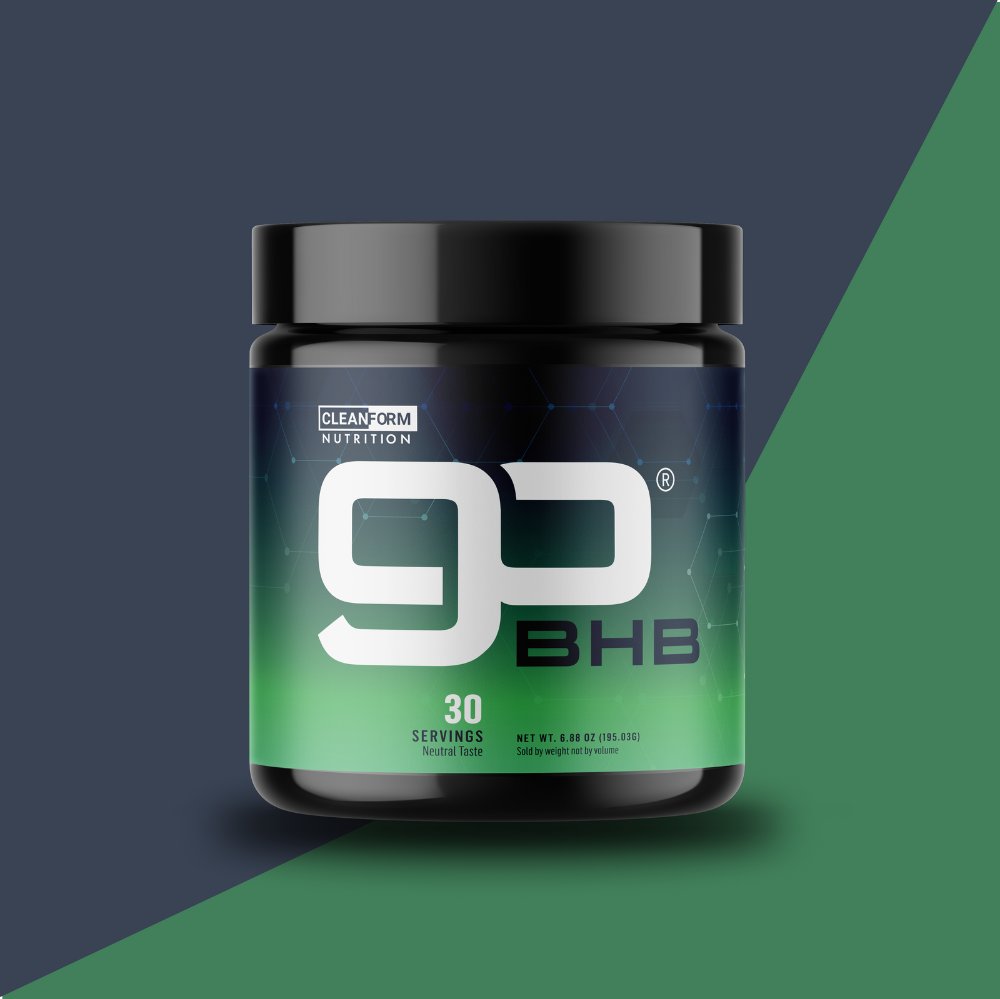
A ketone salt is BHB bound to a mineral, usually sodium, potassium, calcium or magnesium. It’s a powder with a mild salty-tart taste that flavors cover easily. Salts come in two versions: racemic (a 50/50 mix of D-BHB and L-BHB) or D-BHB only. goBHB is a BHB mineral salt, and it’s what you’ll find in products like the CleanForm Nutrition goBHB powder.
Ketone esters
The most studied ester is (R)-3-hydroxybutyl (R)-3-hydroxybutyrate, a BHB molecule attached to R-1,3-butanediol. Your gut splits it, and the liver then converts the butanediol half into more BHB. It’s a liquid, it contains no minerals, and it is almost entirely D-BHB. It’s also famously bitter, and it typically costs more per serving than salts.
Ketone Salts vs Ketone Esters: Blood BHB Head to Head
The cleanest comparison we have is a 2017 Oxford study by Brianna Stubbs and colleagues in Frontiers in Physiology. Fifteen healthy adults drank either a ketone ester or a sodium/potassium BHB salt, matched for the amount of BHB delivered (1.6 or 3.2 mmol per kg of body weight). Peak blood D-BHB hit 2.8 mM after the ester and 1.0 mM after the salt. For both drinks, D-BHB was back to baseline within 3 to 4 hours.
Two details from that paper matter more than the headline. First, the salt was about 50% L-BHB, and the standard blood meters only read D-BHB. In the high-dose salt group (5 people), total BHB (D plus L) peaked at 3.4 mM, and L-BHB was still at 0.7 mM eight hours later. Second, the ester was supplied by TΔS Ltd., and several authors had ties to that company, so keep the funding in mind just as you would for any industry study, including ours.
A 2020 trial in Nutrition & Metabolism (Prins and colleagues) tested a racemic BHB salt plus MCT powder in 13 recreational male distance runners. One serving (about 7 g of BHB salt) raised D-BHB to 0.60 mM at 60 minutes, and two servings reached 0.73 mM. So yes, salts produce a lower D-BHB peak than esters.
Peak blood D-BHB after a single drink
Millimolar (mM) D-BHB measured in human studies. Meters read D-BHB only.
Sources: Stubbs et al., Front Physiol 2017; Prins et al., Nutr Metab 2020. Prins values measured at 60 minutes. Salt values exclude L-BHB.
Does a Higher Peak Mean Better Results?
This is where I think the ester crowd overreaches. A higher meter reading doesn’t automatically mean a better outcome.
Endurance performance
The best-known ester result is Cox and colleagues in Cell Metabolism (2016). Trained cyclists who added a ketone ester to a carbohydrate drink covered about 2% more distance (roughly 400 m) in a 30-minute time trial than with carbohydrate alone. That’s a meaningful number for an elite athlete, though it came from a single study using one protocol.
For salts, the Prins trial above found no difference in 5 km run time: 1,289 seconds with one serving, 1,307 seconds with two, and 1,291 seconds with placebo. The single-drink performance evidence is thin for both forms.
Blood glucose
A 2022 meta-analysis in Advances in Nutrition (Falkenhain and colleagues, 43 trials, 586 participants) found that a single dose of exogenous ketones lowered blood glucose by an average of 0.54 mmol/L compared with before the drink. Monoesters had a larger effect than salts. Evidence on longer-term use is limited. We covered that in more detail in our breakdown of exogenous ketones and blood sugar.
Body composition
Here the only multi-week human data comes from salts and D-BHB. In the KETAD trial (Nutrients, 2025), overweight and obese adults (BMI 27 to 35) on a modest calorie deficit took 10 g/day of racemic BHB salts or placebo for 8 weeks. The BHB group lost 3.05 kg vs. 1.51 kg of body weight and 1.97 kg vs. 0.82 kg of fat mass. The weight difference was a non-significant trend (p = 0.09), and fat mass did not differ significantly between groups. Ketone Labs, our company, funded that study. In a 12-week Japanese trial of 100 adults with a BMI of 23 to 30 and high visceral fat (Obesities, 2025), 1.5 or 2.9 g/day of D-BHB reduced visceral fat area by about 11 cm² vs. placebo. That D-BHB came from Osaka Gas Chemicals, whose staff co-authored the paper.
Ketone Salts vs Esters at a Glance
| BHB salts | Ketone ester | |
| Form | Powder, drinks, shots, bars | Liquid |
| D-BHB peak (matched dose) | About 1.0 mM | About 2.8 mM |
| L-BHB | Yes, if racemic (lasts 8+ hours) | Almost none |
| Minerals | Sodium, potassium, calcium, magnesium | None |
| Taste | Mild, easy to flavor | Very bitter |
| Multi-week human trials | KETAD (8 weeks), Katsuya D-BHB (12 weeks) | Few |
Why I Still Build Products With Salts
A daily product has to taste fine, mix into a can or scoop, and cost little enough that people use it for the 8 to 12 weeks where the body composition data lives. Salts check those boxes. That’s why goBHB shows up in everything from a 12 oz energy drink to a pre-workout.

The L-BHB question is worth a mention too. Esters give you almost pure D-BHB, while racemic salts deliver both. L-BHB lingers in the blood far longer, as the Stubbs data showed, and goBHB Labs has a trial planned that compares L-BHB with D-BHB directly. Until that data exists, I won’t claim L-BHB does more than the evidence shows. If you want the background, read D-BHB vs L-BHB: What Formulators Need to Know.
Safety Notes for Both Forms
Salts carry minerals, so a big serving can add a few hundred milligrams of sodium or more. If you’re watching sodium for blood pressure, have kidney problems, or take medication that affects potassium, read the label and talk to your doctor first. In the KETAD trial, 10 g/day of BHB salts for 8 weeks produced no adverse changes in blood pressure, heart rate, or liver or kidney markers. Esters avoid the minerals but lowered blood pH from 7.41 to 7.31 in the Stubbs study, a temporary shift worth knowing about. Pregnant or nursing women should skip exogenous ketones unless a physician says otherwise.
Where the Evidence Stands
Esters raise blood D-BHB nearly three times higher than matched doses of salts. Both forms lower blood glucose after a single dose, with esters having the larger effect. Single-drink performance benefits are inconsistent for both. The multi-week trials on body composition used BHB salts and D-BHB at 1.5 to 10 g per day, with industry funding or industry authors in each case. None of these products are meant to treat or prevent any disease.
FAQ
Are ketone esters better than ketone salts?
Esters raise blood D-BHB higher and faster, which may matter for short research protocols or elite endurance work. Salts are easier to take daily, taste better and cost less, and they have the longer human trials behind them. “Better” depends on the job you want the product to do.
Do ketone salts actually raise ketones?
Yes. Matched doses of salts raised D-BHB to about 1.0 mM in the Stubbs study, and racemic salts add L-BHB that a standard meter doesn’t read. If you want to check your own response, see our guide to testing BHB levels.
Are ketone salts bad for your kidneys?
In the 8-week KETAD trial, 10 g/day of BHB salts produced no adverse changes in kidney markers in overweight adults. People with existing kidney problems or on a sodium or potassium restriction should check with their doctor before using any mineral salt supplement.
The Bottom Line
If your only goal is the highest number on a ketone meter, an ester wins. If you want something you can take every day in a drink, powder or pre-workout, at the doses used in the 8 to 12 week human trials, salts make more sense, and that’s the bet we’ve made with goBHB. Either way, check the dose, the form and the funding before you believe a claim, including mine.
Sources: Stubbs BJ, et al. On the Metabolism of Exogenous Ketones in Humans. Front Physiol. 2017;8:848. Prins PJ, et al. Dose response of a novel exogenous ketone supplement on physiological, perceptual and performance parameters. Nutr Metab. 2020. Cox PJ, et al. Nutritional Ketosis Alters Fuel Preference and Thereby Endurance Performance in Athletes. Cell Metab. 2016;24(2):256-268. Falkenhain K, et al. Effects of Exogenous Ketone Supplementation on Blood Glucose: A Systematic Review and Meta-analysis. Adv Nutr. 2022;13(5):1697-1714. Roeth EJ, et al. Effect of Exogenous Ketones as an Adjunct to Low-Calorie Diet on Metabolic Markers. Nutrients. 2025;17(22):3582 (funded by Ketone Labs). Katsuya S, et al. Effect of D-β-Hydroxybutyric Acid on Body Fat in Japanese Adults. Obesities. 2025;5(4):82. Product details from CleanForm Nutrition and drinkmac.com.