
Studies
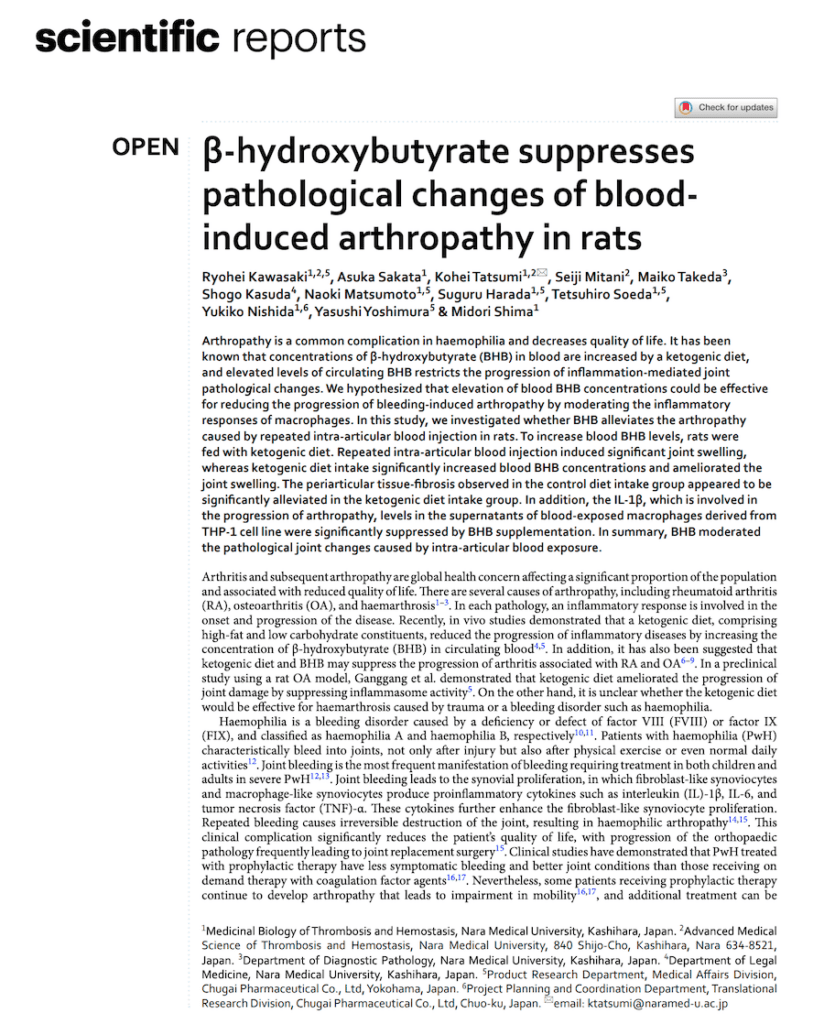
β-hydroxybutyrate suppresses pathological changes of blood-induced arthropathy in rats
Arthropathy is a common complication in haemophilia and decreases quality of life. It has been known that concentrations of β-hydroxybutyrate (BHB) in blood are increased by a ketogenic diet, and elevated levels of circulating BHB restricts the progression of inflammation-mediated joint pathological changes. We hypothesized that elevation of blood BHB concentrations could be effective for reducing the progression of bleeding-induced arthropathy by moderating the inflammatory responses of macrophages. In this study, we investigated whether BHB alleviates the arthropathy caused by repeated intra-articular blood injection in rats. To increase blood BHB levels, rats were fed with ketogenic diet. Repeated intra-articular blood injection induced significant joint swelling, whereas ketogenic diet intake significantly increased blood BHB concentrations and ameliorated the joint swelling. The periarticular tissue-fibrosis observed in the control diet intake group appeared to be significantly alleviated in the ketogenic diet intake group. In addition, the IL-1β, which is involved in the progression of arthropathy, levels in the supernatants of blood-exposed macrophages derived from THP-1 cell line were significantly suppressed by BHB supplementation. In summary, BHB moderated the pathological joint changes caused by intra-articular blood exposure.

Effect of beta-hydroxybutyrate on whole-body leucine kinetics and fractional mixed skeletal muscle protein synthesis in humans
Because intravenous infusion of beta-hydroxybutyrate (beta-OHB) has been reported to decrease urinary nitrogen excretion, we investigated in vivo metabolism of leucine, an essential amino acid, using L-[1-13C]leucine as a tracer during beta-OHB infusion. Leucine flux during beta-OHB infusion did not differ from leucine flux during normal saline infusion in nine normal subjects, whereas leucine oxidation decreased 18-41% (mean = 30%) from 18.1 +/- 1.1 mumol.kg-1.h-1 (P less than 0.01), and incorporation of leucine into skeletal muscle protein increased 5-17% (mean = 10%) from 0.048 + 0.003%/h (P less than 0.02). Since blood pH during beta-OHB infusion was higher than the pH during saline infusion, we performed separate experiments to study the effect of increased blood pH on leucine kinetics by infusing sodium bicarbonate intravenously. Blood pH during sodium bicarbonate infusion was similar to that observed during the beta-OHB infusion, but bicarbonate infusion had no effect on leucine flux or leucine oxidation. We conclude that beta-OHB decreases leucine oxidation and promotes protein synthesis in human beings.
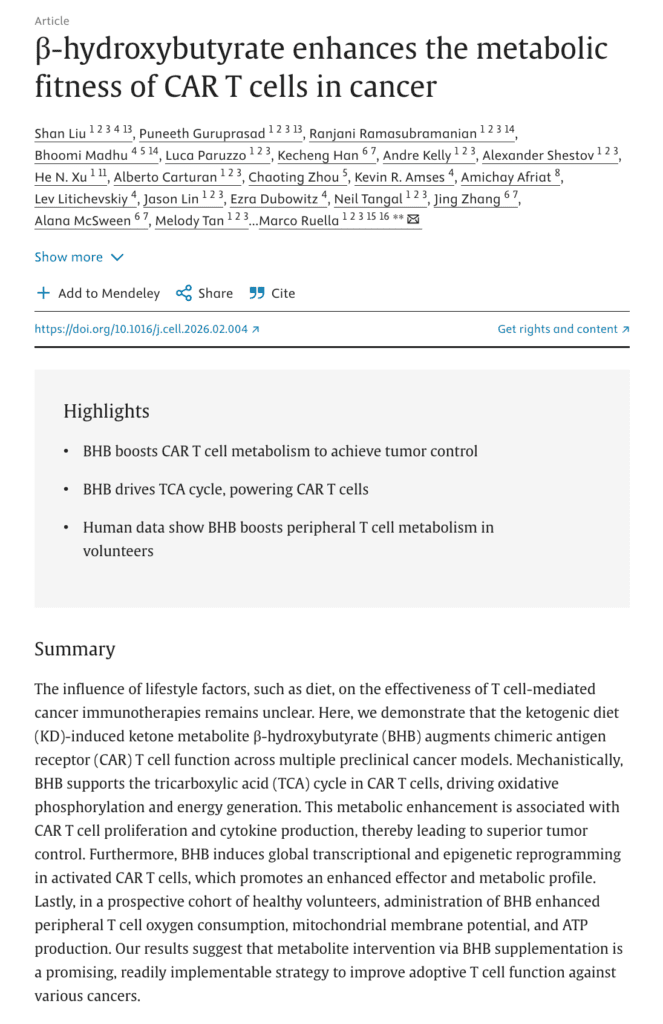
β-hydroxybutyrate enhances the metabolic fitness of CAR T cells in cancer
The influence of lifestyle factors, such as diet, on the effectiveness of T cell-mediated cancer immunotherapies remains unclear. Here, we demonstrate that the ketogenic diet (KD)-induced ketone metabolite β-hydroxybutyrate (BHB) augments chimeric antigen receptor (CAR) T cell function across multiple preclinical cancer models. Mechanistically, BHB supports the tricarboxylic acid (TCA) cycle in CAR T cells, driving oxidative phosphorylation and energy generation. This metabolic enhancement is associated with CAR T cell proliferation and cytokine production, thereby leading to superior tumor control. Furthermore, BHB induces global transcriptional and epigenetic reprogramming in activated CAR T cells, which promotes an enhanced effector and metabolic profile. Lastly, in a prospective cohort of healthy volunteers, administration of BHB enhanced peripheral T cell oxygen consumption, mitochondrial membrane potential, and ATP production. Our results suggest that metabolite intervention via BHB supplementation is a promising, readily implementable strategy to improve adoptive T cell function against various cancers.
Acute Effects of D- and L-Beta-Hydroxybutyrate on Vigilance (Sustained Attention and Reaction Speed) in Healthy Adults: A Randomized, Double-Blind, Placebo- Controlled Trial
This study evaluated whether a low dose, acute ingestion of beta- hydroxybutyrate (D-BHB) or L-BHB influences vigilance (i.e., sustained attention, reaction speed), fine motor control, memory, mood, or strength in fasted, non–keto-adapted healthy adults. A total of 136 participants (20.5 ± 1.4 years; 70.2 ± 15.6 kg) were randomized into 3 Groups: D-BHB (n = 47), L-BHB (n = 46), or placebo (n = 43). Measures included the Psychomotor Vigilance Test (PVT reaction time) and handgrip strength (mean and peak). Assessments were conducted at baseline and 60 minutes post-consumption. The data were analyzed using a two-way ANOVA with post hoc Tukey Tests where appropriate. An exploratory analysis was also conducted to assess within-group changes over time and to estimate effect sizes. A significant group effect was found for reaction time (P = 0.033). Group B (L- BHB) performed significantly faster than placebo (P = 0.029). No time or interaction effects we noted. Lapse counts were higher in the Placebo Group compared to both BHB Groups (P = 0.004). The ANOVA did not show a significant group × time interaction.
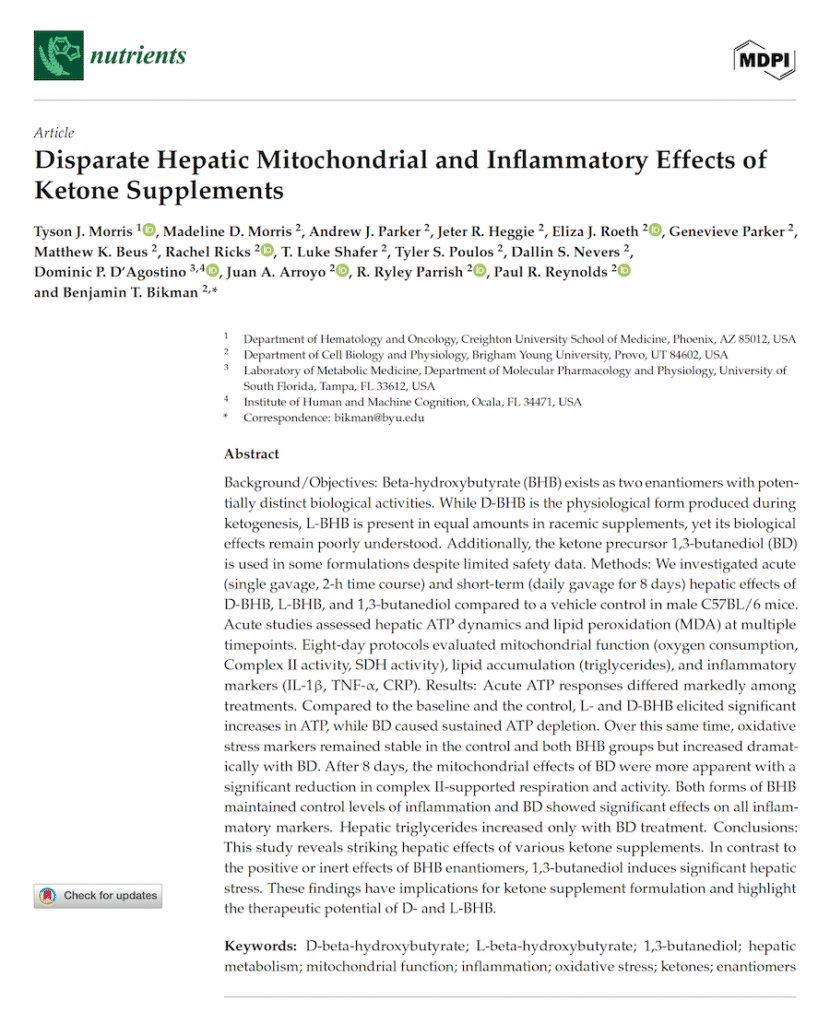
Disparate Hepatic Mitochondrial and Inflammatory Effects of Ketone Supplements
Background/Objectives: Beta-hydroxybutyrate (BHB) exists as two enantiomers with potentially distinct biological activities. While D-BHB is the physiological form produced during ketogenesis, L-BHB is present in equal amounts in racemic supplements, yet its biological effects remain poorly understood. Additionally, the ketone precursor 1,3-butanediol (BD) is used in some formulations despite limited safety data. Methods: We investigated acute (single gavage, 2-h time course) and short-term (daily gavage for 8 days) hepatic effects of D-BHB, L-BHB, and 1,3-butanediol compared to a vehicle control in male C57BL/6 mice. Acute studies assessed hepatic ATP dynamics and lipid peroxidation (MDA) at multiple timepoints. Eight-day protocols evaluated mitochondrial function (oxygen consumption, Complex II activity, SDH activity), lipid accumulation (triglycerides), and inflammatory markers (IL-1β, TNF-α, CRP). Results: Acute ATP responses differed markedly among treatments. Compared to the baseline and the control, L- and D-BHB elicited significant increases in ATP, while BD caused sustained ATP depletion. Over this same time, oxidative stress markers remained stable in the control and both BHB groups but increased dramatically with BD.
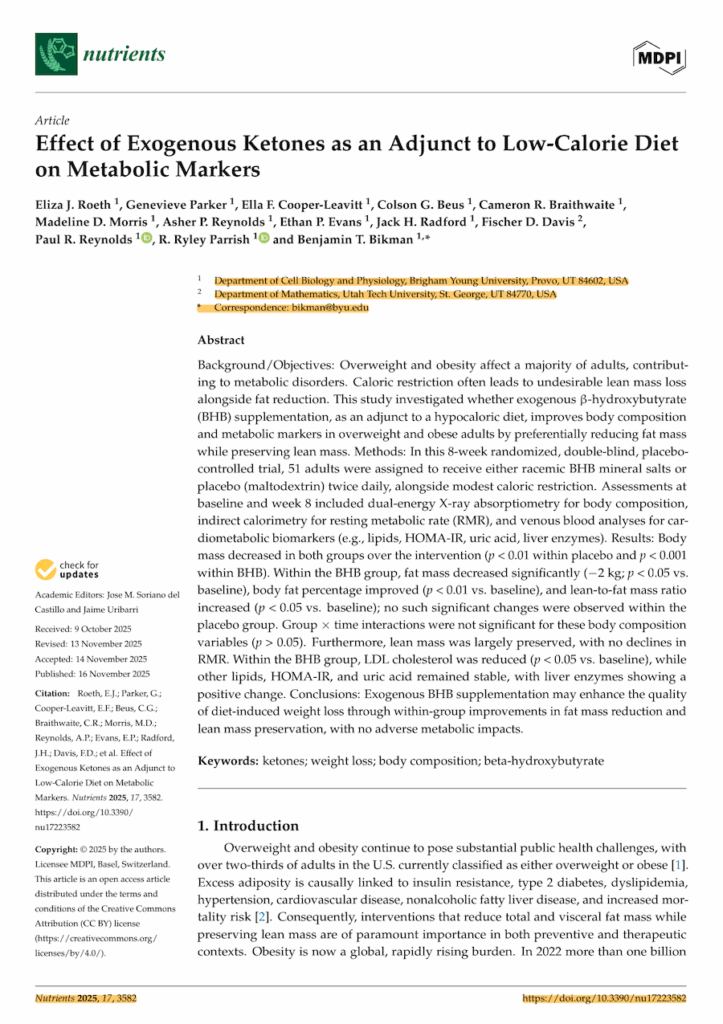
Effect of Exogenous Ketones as an Adjunct to Low-Calorie Diet on Metabolic Markers
Background/Objectives: Overweight and obesity affect a majority of adults, contribut- ing to metabolic disorders. Caloric restriction often leads to undesirable lean mass loss alongside fat reduction. This study investigated whether exogenous β-hydroxybutyrate (BHB) supplementation, as an adjunct to a hypocaloric diet, improves body composition and metabolic markers in overweight and obese adults by preferentially reducing fat mass while preserving lean mass. Methods: In this 8-week randomized, double-blind, placebo- controlled trial, 51 adults were assigned to receive either racemic BHB mineral salts or placebo (maltodextrin) twice daily, alongside modest caloric restriction. Assessments at baseline and week 8 included dual-energy X-ray absorptiometry for body composition, indirect calorimetry for resting metabolic rate (RMR), and venous blood analyses for car- diometabolic biomarkers (e.g., lipids, HOMA-IR, uric acid, liver enzymes). Results: Body mass decreased in both groups over the intervention (p < 0.01 within placebo and p < 0.001 within BHB). Within the BHB group, fat mass decreased significantly (−2 kg; p < 0.05 vs. baseline), body fat percentage improved (p < 0.01 vs. baseline), and lean-to-fat mass ratio increased (p 0.05). Furthermore, lean mass was largely preserved, with no declines in RMR. Within the BHB group, LDL cholesterol was reduced (p < 0.05 vs. baseline), while other lipids, HOMA-IR, and uric acid remained stable, with liver enzymes showing a positive change. Conclusions: Exogenous BHB supplementation may enhance the quality of diet-induced weight loss through within-group improvements in fat mass reduction and lean mass preservation, with no adverse metabolic impacts.