
Walk into almost any supplement store today and you’ll find multiple products promising to “boost ketones.”
Some contain MCT oil.
Others contain beta-hydroxybutyrate (BHB).
The packaging often looks similar.
The marketing language sounds similar.
Both may mention ketosis, cognitive performance, clean energy, or metabolic health.
So they’re basically the same…
Right?
Not quite.
The reality is that MCT oil and BHB are two very different molecules that work through two very different metabolic pathways.
Understanding that difference can help consumers make more informed decisions about what they’re actually buying.
MCT Oil: A Ketone Precursor
MCT (medium-chain triglyceride) oil is a dietary fat.
Most commercial MCT products contain a combination of C8 (caprylic acid) and C10 (capric acid), both of which are absorbed differently than long-chain fats.
Once consumed, MCTs travel to the liver, where they can be converted into ketone bodies.
That word—can—is important.
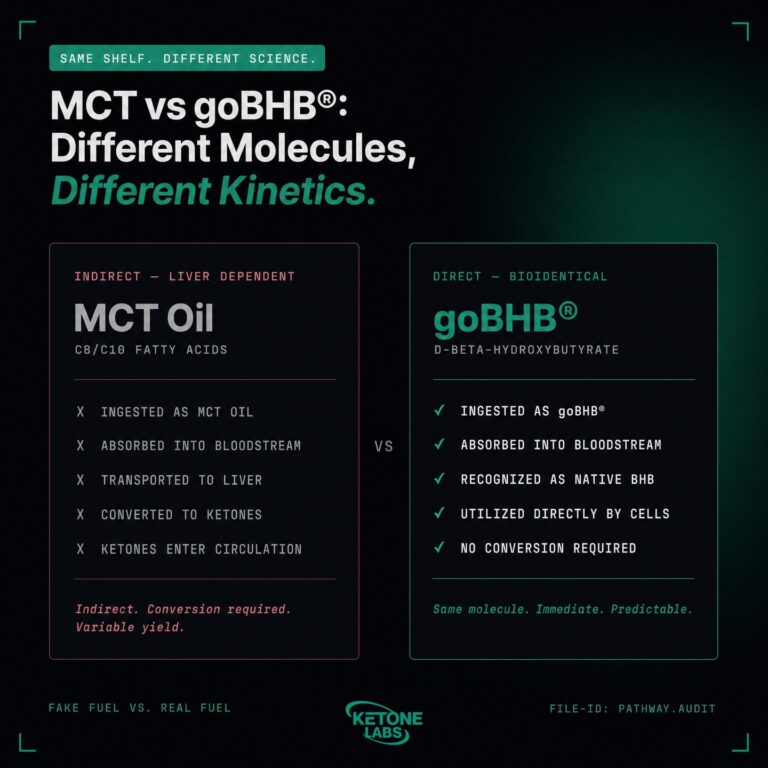
Producing ketones from MCT oil requires several metabolic steps:
Digestion and absorption
Transport to the liver
Hepatic conversion into ketones
Release of those ketones into circulation
The amount of BHB ultimately produced depends on multiple variables, including dosage, meal timing, individual metabolism, liver function, carbohydrate intake, and overall metabolic state.
In other words, when you purchase MCT oil, you’re purchasing a raw material that your body may convert into ketones.
goBHB®: Direct Ketone Delivery
goBHB® works differently.
Rather than providing a fat that must first be converted, goBHB® delivers beta-hydroxybutyrate itself—the same ketone body naturally produced by the liver during fasting, prolonged exercise, or nutritional ketosis.
Because the molecule is already BHB, it doesn’t require hepatic conversion before becoming available.
Once ingested, it is absorbed into the bloodstream and recognized by the body as native beta-hydroxybutyrate.
That means the ingredient listed on the label is the same molecule being delivered to the body.
No intermediary conversion.
No waiting for ketone production to occur.
Different Pathways. Different Kinetics.
Although both products are often discussed within the context of ketosis, their metabolic behavior is fundamentally different.
MCT oil follows an indirect pathway:
Consume MCT fat
Transport to the liver
Convert fat into ketones
Release ketones into circulation
goBHB® follows a direct pathway:
Consume BHB
Absorb into circulation
Utilize as beta-hydroxybutyrate
These differences affect not only how each ingredient works, but also how quickly ketones become available and how predictable ketone delivery may be.
Why It Matters
Consumers are becoming increasingly interested in ketone supplementation for applications ranging from sports performance and cognitive support to metabolic health and healthy aging.
As the category grows, ingredient transparency becomes increasingly important.
Not every product marketed as a “ketone product” is actually delivering ketones.
Some provide ingredients that may increase ketone production under the right conditions.
Others provide beta-hydroxybutyrate directly.
Understanding that distinction allows consumers, formulators, and healthcare professionals to better evaluate products based on what they’re designed to deliver—not simply how they’re marketed.
Same Shelf. Different Science.
At first glance, MCT oil and BHB products may appear to occupy the same category.
But metabolically, they’re very different.
MCT oil provides a fat that may eventually become ketones.
goBHB® provides beta-hydroxybutyrate directly.
If a product promises ketones, it’s worth asking one simple question:
Which ketone is it actually delivering?
Sometimes the most important difference isn’t what’s printed on the front of the label.
It’s the molecule inside.