Not All Ketones Are Created Equal: What the Liver Data Really Tells Us
By: Marc Lobliner, IFBB Pro
Not All Ketones Are Created Equal: What the Liver Data Really Tells Us
If you have followed my work long enough, you know I am not impressed by buzzwords. “Ketones” became one of those words that got slapped on everything without anyone asking the hard questions. This study forces those questions into the open, and it confirms something I have been saying for years. The delivery system matters. The molecule matters. And the liver absolutely keeps score.
This paper does not look at marketing claims. It looks at biology. Specifically, what actually happens in the liver when you ingest different ketone sources. That is where the truth always shows up.
What This Study Looked At and Why It Matters
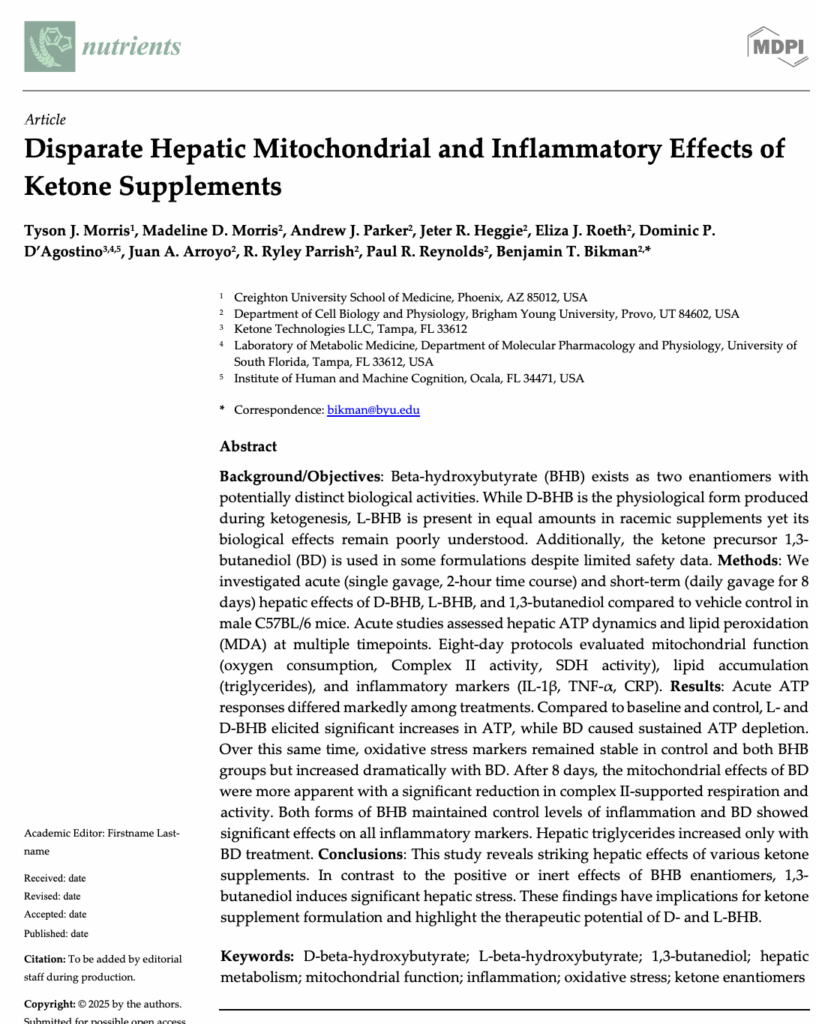
The researchers compared three common approaches used in ketone products. D-beta-hydroxybutyrate (D-BHB), which is the same ketone your body produces during fasting or carbohydrate restriction. L-beta-hydroxybutyrate (L-BHB), which is not produced in meaningful amounts endogenously but is present in racemic ketone products. And 1,3-butanediol, a ketone precursor that must be converted by the liver through alcohol-style metabolic pathways.
They examined both short-term and repeated exposure. Acute effects were measured over two hours, and short-term use was assessed with daily dosing over eight days. They measured liver ATP, oxidative stress, mitochondrial respiration, inflammation, and liver fat accumulation. These are not surface-level markers. These are core indicators of whether something supports metabolism or stresses it.
The Liver’s Immediate Reaction Tells the First Story
When the mice received D-BHB or L-BHB, liver ATP increased. That is exactly what you want to see from a functional energy molecule. The liver had more usable energy available, quickly and efficiently.
This is a critical distinction. goBHB® provides direct cellular energy. It does not need to be metabolized through detox pathways or converted at metabolic cost. It delivers energy that the body can immediately use to support ATP production across tissues.
When the mice received 1,3-butanediol, ATP dropped sharply. This is not a subtle finding. 1,3-butanediol actively depleted ATP in the liver. That means the liver had to spend energy just to process it before any ketone benefit could even exist. That is not energy delivery. That is energy debt.
Any compound that lowers ATP in the liver is not acting as fuel. It is acting as stress.
Oxidative Stress Exposes the Metabolic Cost
Alongside ATP changes, the researchers measured oxidative stress using malondialdehyde. With both D-BHB and L-BHB, oxidative stress remained stable or trended lower than control. That indicates metabolic neutrality or protection.
With 1,3-butanediol, oxidative stress climbed rapidly and remained elevated. Combine ATP depletion with rising oxidative stress and you get a classic hepatic stress signature. This mirrors what we know about alcohol metabolism, which is not surprising given that 1,3-butanediol uses the same enzyme systems.
Repeated Use Made the Differences Impossible to Ignore
After eight days, the gap between these compounds widened.
D-BHB and L-BHB maintained normal mitochondrial respiration. The liver’s energy systems functioned the way they should. Inflammatory markers stayed at baseline. Liver fat remained normal.
1,3-butanediol did the opposite. Mitochondrial respiration through complex II declined. Inflammatory markers including TNF-alpha, IL-1 beta, and CRP rose significantly. Hepatic triglycerides increased.
This is not adaptation. This is cumulative metabolic stress.
Why This Happens Comes Down to Pathways
goBHB® delivers beta-hydroxybutyrate directly. D-BHB enters normal ketone oxidation pathways and feeds the TCA cycle cleanly, increasing ATP availability. L-BHB follows a different metabolic and signaling route, but this study shows it does not compromise liver energy or inflammatory balance.
1,3-butanediol is fundamentally different. It is not a ketone. It is a precursor that must be converted by alcohol and aldehyde dehydrogenases. That conversion consumes NAD+, disrupts redox balance, and places an energetic burden on the liver before any ketone benefit exists. The result is ATP depletion, oxidative stress, inflammation, and fat accumulation.
This is why blood ketone levels alone are misleading. 1,3-butanediol can raise ketones while simultaneously draining energy at the tissue level. goBHB® raises ketones while providing energy.
Real-World Application: What This Means for Actual People
For athletes, this matters because performance is built on recovery and mitochondrial health. Using a compound that depletes ATP in the liver is not supporting training. It is quietly interfering with it. goBHB® supports energy availability without imposing a metabolic tax.
For professionals using ketones for focus and productivity, liver stress is the last thing you want layered on top of long workdays, poor sleep, and chronic stress. goBHB® provides non-stimulant energy without the crash or biochemical strain.
For anyone over 40 or managing metabolic health, the liver is central to insulin sensitivity, lipid handling, and hormone regulation. A product that increases liver triglycerides and inflammatory signaling is working against long-term health goals.
This is where formulation choices become ethical choices.
Why This Changes How Ketones Should Be Viewed
Ketones are not one ingredient. They are a category of molecules with very different biological consequences depending on how they are delivered.
This study reinforces a simple truth. goBHB® delivers energy. 1,3-butanediol extracts energy before it ever gives anything back.
What I Tell People When They Ask About Ketones
Ketones are a tool. Used correctly, they support energy, focus, and metabolic flexibility. Used incorrectly, they create problems that take longer to show up than the marketing claims.
If you are going to use ketones, use the form your body already recognizes. Respect the liver. Respect ATP. Respect mitochondrial health.
The Bottom Line
This research makes one thing clear. goBHB®, whether in D- or L-form, supports liver energy and stability. 1,3-butanediol depletes ATP, increases oxidative stress, drives inflammation, and promotes liver fat accumulation.
Raising ketones is not the goal. Supporting cellular energy is.
The liver does not care about trends. It cares about pathways. And this study shows exactly which path leads to energy and which leads to stress.